Project
Rock Polisher
A heavy-duty wet grinding and polishing machine I designed and built for Petoskey stones and other soft rocks.
I based the concept on a cabbing machine, but designed it to be heavier, more configurable, and better suited to the way I work. The finished machine uses a long adjustable spindle, removable guards, a high-power belt drive, and movable water delivery so the wheel arrangement can change with the job.
01 / Purpose
Why I built it
I wanted a faster and easier way to polish Petoskey stones and other rocks with similar hardness. Commercial rock polishers became expensive once configured with a complete set of diamond wheels, and because I already had access to machining and fabrication equipment, I decided to design my own.
My goal was not simply to copy an existing machine for less money. I wanted more power, a longer and less restrictive spindle, better containment, and the ability to rearrange or replace wheels without being locked into a fixed factory layout.
- Primary use
- Wet grinding and polishing of soft rocks
- Typical wheels
- 6 planned; configurable layout
- Spindle
- ~36 in / 304 stainless
- Motor
- 1.5 hp / 120 V
- Wheel speed
- ~1,700 rpm
- Wheel diameter
- 6 in / 8 in
- Drive
- V-belt / 2:1 reduction
- Bearings
- Custom aluminum blocks / bronze sleeves
- Machine base
- ~3 x 1 x 36 in aluminum
- Guards
- TIG-welded painted steel
- Water
- Pump / adjustable Loc-Line
- Machine cost
- ~$200-$300, excluding wheels
- Active build time
- ~40 hours
02 / Process
Why wet wheel grinding
Petoskey stones are fossilized coral typically found in limestone and are much softer than agates, jaspers, and other stones commonly polished in a tumbler. Prolonged tumbling can keep wearing away and undercutting the surface instead of progressing cleanly toward a final polish.
A wet grinding machine gives me direct control over the pressure and the time spent at each grit. Water delivered directly to the wheel keeps everything wet to reduce airborne dust, carries slurry away, and keep the wheels from clogging.
Abrasive progression
The wheel arrangement can change, but the progression I am using moves from coarse shaping through increasingly fine diamond abrasives before a final buffing or polishing stage.
120 / 220 / 500 / 1000 / 2000 / 3000
03 / Mechanical design
A configurable shop-built machine
Spindle and wheels
The center of the design is an approximately 36-inch-long 304 stainless-steel spindle made from turned, ground, and polished shafting. Adjustable collars and hubs allow each wheel to be positioned anywhere along the largely bare shaft, changing the number, width, and spacing of the wheels without redesigning the machine.
Motor and belt drive
A 120 V, 1.5 hp VEVOR pool-pump motor runs at approximately 3,400 rpm and drives the spindle through a 2:1 V-belt reduction. The resulting wheel speed is roughly 1,700 rpm, with increased torque and the motor kept outside the wet grinding area.
Custom bearing blocks
I designed and machined compact aluminum bearing housings fitted with bronze sleeve bearings and grease fittings. This gave me control over shaft height, support geometry, mounting pattern, stiffness, and service access.
Frame and guarding
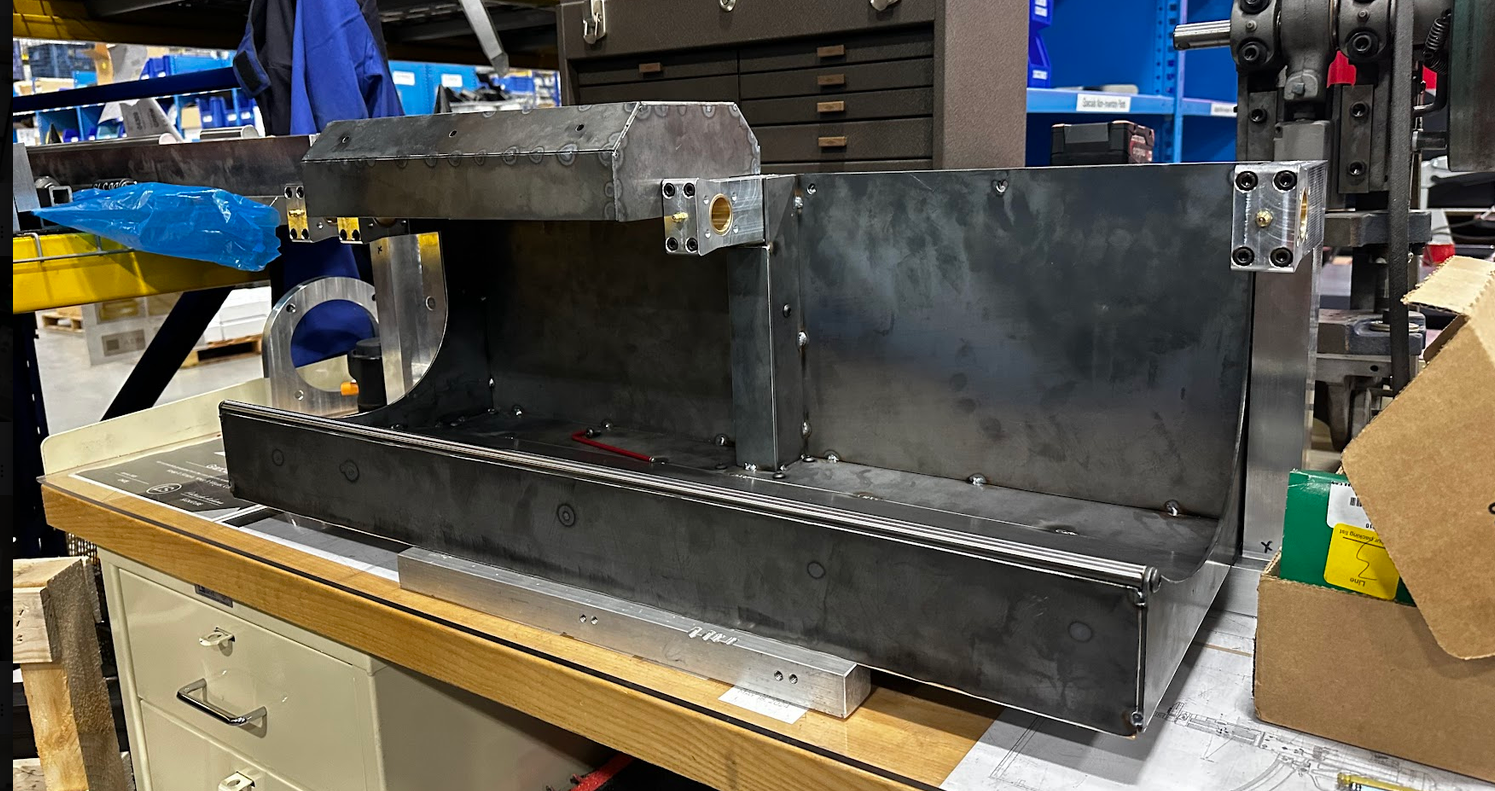
A welded square-steel-tube stand on casters supports a precision aluminum machine base and machined uprights. TIG-welded steel guards and a large lower trough contain water and grinding slurry across the full working width, while removable upper sections provide wheel access.
Adjustable water delivery
A small pump feeds flexible Loc-Line to the grinding area. Each wheel can receive water exactly where needed, and the nozzles can be repositioned whenever the wheel arrangement changes.
3D model
rock-polisher-assembly.glb
04 / Build and evaluation
From SolidWorks to the shop
I designed the machine in SolidWorks and worked through several layout iterations before building the final version. The project combined CNC machining, turned components, TIG-welded sheet-metal fabrication, painting, mechanical assembly, and final test fitting. I manufactured every custom component myself.
The CAD work took about a week of intermittent design time. Manufacturing stretched over roughly two to three weeks, followed by test fitting, disassembly, cleaning, painting, and final assembly. The project represents roughly 40 hours of active work overall.
What I would revise
I would redesign the spindle supports so the shaft could be lowered into open-top bearing geometry and retained with caps. I would also make the removable upper guard quicker to release and accurately relocate during wheel changes.
Result
The finished machine has the power I wanted, the long spindle provides much more freedom than a fixed six-wheel cabber, and the enclosure contains water and slurry effectively. Most importantly, it lets me take a soft limestone specimen from rough grinding through a final finish with direct control over each stage.